



The geometry behind Kanchi "TEMPLE BORDER" calculations
The geometry behind Kanchi temple border calculations
The stepped triangle you see on a Kanjivaram border is not decorative inspiration loosely drawn from a temple tower. It is the temple tower — translated tier by tier, proportion by proportion, into thread counts and weft rows. The weavers are applying architecture. Not imitating it.
Stand in front of the Ekambareshwarar temple in Kanchipuram and look up at the gopuram. Count the tiers. Each one is slightly smaller than the one below it — stepped, precise, pyramidal. Now look at the border of a traditional Kanjivaram saree. Count the steps in the temple triangle. The proportion is the same. The weavers were not inspired by the temple. They were measuring it.
The saree border as architectural drawing
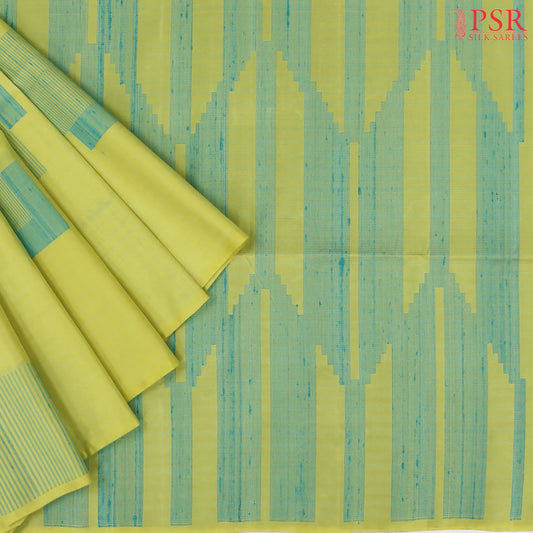
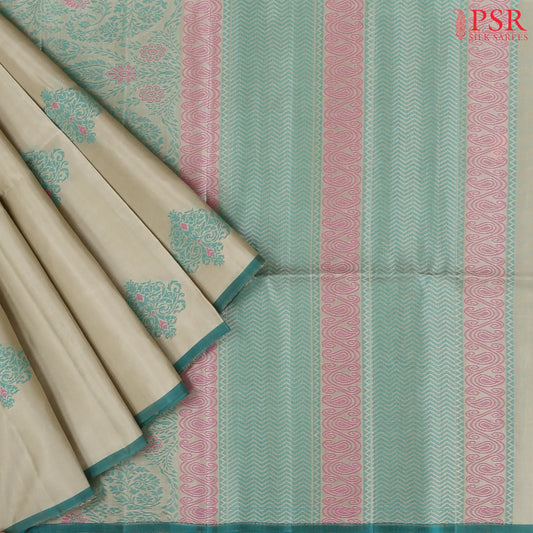
The Kanjivaram temple border is one of the most recognised motifs in Indian textile tradition. Nearly every buyer knows what it looks like: a row of stepped triangular shapes running along the border of the saree, each one resembling a pyramid or spire. What almost no one knows — unless they have stood in front of the temple — is how precisely these shapes correspond to actual Dravidian architecture.
The Dravidian vimana, the main tower above a temple's inner sanctum, rises in a stepped pyramidal form. Each tier of the vimana is a bit smaller than the one below, increasing geometrically rather than curving — unlike the Nagara style towers of North India, which are curvilinear. This stepped geometric ascent — widest at the base, narrowing in fixed proportions toward the crown — is not just a visual choice. It is a structural and cosmological principle encoded in the Vastu Shastra texts that govern temple construction. The tower ascends toward the divine in a series of measured diminishments, each step representing a plane of increasingly subtle existence.
The weavers of Kanchipuram, living in the shadow of the Ekambareshwarar temple and the Kamakshi Amman temple, translated this geometric principle directly into the language of thread. The stepped triangles of the temple border are not impressionistic evocations of a temple tower's silhouette. They are the tower's proportion system, rendered in silk and gold.
The motifs and layouts have been strongly influenced by Dravidian temple architecture: borders modelled on temple gopurams, checks reminiscent of stone latticework, and floral vines inspired by carved pillars. This synthesis was not accidental. Kanchipuram is itself one of the sacred temple towns of Tamil Nadu — a city where the relationship between the sacred architecture above ground and the domestic craft within weaving homes was never a metaphor. It was a daily visual and cultural reality.
Dravidian gopuram cross-section
Temple border rekku — woven
The spire motif
The word rekku means "feather" or "wing" in Tamil. In border design, it refers to the individual stepped spire shapes that run along the border — each one a miniature gopuram, complete with tiers and a pointed crown. The rekku is the fundamental unit of the temple border. Everything else in the design is either a rekku, a variation of one, or a spacer between them.
The joining technique
Korvai is both the joining technique (the three-shuttle interlocking of body and border) and the design style it produces. The korvai joint creates the zigzag line where body meets border — and the temple spires of the rekku design are woven in this join zone, their stepped shapes emerging directly from the interlocking geometry of the two separately woven fabrics.
The Ganesha bud
When the gopuram is morphed into a softer, rounded triangular bud shape, it becomes the pillayar moggu — the "Ganesha bud." This is a rounder interpretation of the same stepped ascent principle, named after the elephant god and often used in smaller-scale borders or as a spacer between full rekku spires in the six-rekku border design.
The solid end-border
The gettipettu is the broad, solid zari band at the very end of the saree — the outermost border stripe that frames the entire composition. It adds structural weight to the selvedge edge (the section that takes the most wear) and provides the anchor from which the rekku spires rise into the body of the border.
The kewra flower spire
The tazhambu is the screw pine or kewra flower — a spike-shaped bloom from the coastal Tamil landscape. The tazhambu rekku is a border spire that curves slightly at its tip like the kewra flower's leaf, giving the border a more organic quality while retaining the same stepped structural base as the temple gopuram spire.
The six-spired full border
The most elaborate standard temple border configuration: six full gopuram spires with a single smaller pillayar moggu spacer between each pair. This arrangement fills the full width of the border band with a continuous rhythm of ascending and descending stepped shapes, creating the characteristic dense geometric richness of a formal Kanjivaram bridal saree border.
Each step of the rekku must be narrower than the one below — in a fixed ratio
The Dravidian vimana rises in tiers where each storey (tala) is geometrically smaller than the one below it — the width reduces in a consistent proportion from base to crown. In the woven rekku, this translates directly: each step of the spire occupies fewer warp threads than the step below it, and the reduction is constant across every tier.
If the base tier of a rekku spans 24 threads and the reduction is by 4 threads per tier, the tiers are 24, 20, 16, 12, 8, 4 — six tiers to a point. This is not an approximation of the temple's geometry. It is the temple's geometry encoded as a thread count. Change the reduction to 3 threads per tier, and you get a taller, narrower spire — a different temple's proportion. The weaver who alters the reduction ratio is, in effect, changing which temple's profile they are weaving.
The Dravidian vimanas typically have between five and seven tiers, with thirteen being the maximum in the most elaborate gopurams. A standard Kanjivaram rekku has five to seven steps, with the six-step version being the most common in formal bridal borders.
The rekku height must equal the border width — the square proportion
In traditional Kanjivaram border design, a fundamental proportion rule governs how the rekku spire sits within the border band: the height of a full rekku (measured in weft rows from base to apex) should equal the width of the border band (measured in warp threads from the gettipettu edge to the body). This creates a square compositional unit — each rekku occupies a space as tall as the border is wide.
This is the same principle that governs the proportions of a gopuram gate relative to the compound wall it surmounts: the tower's visible height above the wall should broadly equal the gate's width at its base. The square proportion creates visual stability — the border reads as self-contained and architecturally complete rather than as a band of repeating shapes running arbitrarily along an edge.
When modern designers deviate from this ratio — making the rekku shorter relative to the border width to accommodate thinner borders, or taller to create a more dramatic silhouette — the result is a border that experienced weavers and buyers describe as "wrong" without always being able to articulate why. The proportion is what they are reading.
The distance between rekku spires is determined by the spire's own base width
In the temple itself, gopurams are never solitary — they are placed at regular intervals in the compound wall, and the spacing between gates follows a proportional rule related to the gate's own dimensions. In the saree border, the same logic applies: the distance between the centrelines of adjacent rekku spires is typically equal to twice the base width of a single spire.
A rekku with a base of 24 threads repeats every 48 threads across the length of the border. The spacer between spires — either a flat zari section or a smaller pillayar moggu bud — occupies exactly the gap left by this spacing rule. This means the repeat frequency of the border is not set arbitrarily by the weaver's aesthetic preference. It is calculated from the spire's own geometry. The border's rhythm is an output of the motif's internal proportions, not an independent design decision.
Every rekku must be bilaterally symmetrical — and the axis must align with the border's centreline
A Dravidian gopuram, viewed from the front, has bilateral symmetry: the left half mirrors the right half exactly, with the centreline of the tower aligning with the centreline of the gate opening below it. In the woven rekku, this symmetry is reproduced: each spire is woven identically on both sides of its central vertical axis, and that axis must align precisely with the centreline of the border band.
This rule has a practical consequence for the weaver's thread count. The base width of a rekku must always be an even number of threads, so that the central axis falls between two threads rather than on one. A rekku with an odd-thread base has no true centre — its two halves are asymmetrical by one thread. Traditional weavers are taught this rule early: a temple border with an odd-thread rekku is structurally wrong, regardless of how it looks at a distance.
Every tier must contain a whole number of warp threads — no fractions
This rule is a consequence of the medium. In a woven fabric, a thread either exists or it does not — there are no fractional threads, no sub-pixel positions. A tier that calls for 6.5 threads cannot be woven. This constraint forces the tier-reduction ratio to be chosen from the beginning so that every tier in the series produces a whole number of threads.
A rekku with a base of 24 threads and a reduction of 4 per tier gives: 24, 20, 16, 12, 8, 4 — all whole numbers, all valid. A rekku with a base of 23 threads and a reduction of 4 gives: 23, 19, 15, 11, 7, 3 — also whole numbers, but an odd-thread base violates Rule 4. The calculation of a temple border therefore begins with the constraints of the loom, works backward through the proportion rules, and arrives at the only thread counts that satisfy all five conditions simultaneously. This is not artistic intuition. It is a system of constraints that has exactly one family of correct solutions for any given border width.
Kanchipuram, Tamil Nadu
Ekambareshwarar Temple
The tallest gopuram in Kanchipuram at 58.5 metres, with eleven tiers. The Ekambareshwarar gopuram's eleven-tier stepped proportion is one of the most frequently referenced in Kanjivaram border design — its tall, narrow silhouette corresponds to the elongated rekku profile of formal bridal borders. The weavers of Kanchipuram have this tower visible from their working homes.
11 talas · 58.5 mSrirangam, Tiruchirappalli
Ranganathaswamy Temple
The Ranganathaswamy complex has the largest gopuram in the world — the Rajagopuram — at 72 metres with 13 tiers. Its 13-tala maximum proportion represents the outer limit of the Dravidian tier system, and the gradual reduction ratio across 13 steps is the basis for the widest, most spread-out rekku profiles seen in formal Kanjivaram borders with heavy gettipettu foundations.
13 talas · 72 mMadurai, Tamil Nadu
Meenakshi Amman Temple
The Meenakshi temple's gopurams are renowned for their profuse sculptural decoration across every tier surface — not just the stepped silhouette but the elaborately carved face of each storey. This multi-layered visual density corresponds to the filled rekku style in Kanjivaram borders, where each tier of the spire is itself filled with smaller geometric motifs rather than left as a plain zari band.
9–10 talas · 52 mThanjavur, Tamil Nadu
Brihadeshwara Temple
The Chola-era Brihadeshwara vimana — the main tower above the sanctum, not the outer gopuram — is a single tapering pyramid rising 66 metres in thirteen stories. Unlike the more elaborate later gopurams, the Brihadeshwara vimana has a more severe, minimal proportion: wide base, steep taper, small crown. This simpler stepped silhouette corresponds to the plain, unadorned rekku style of older and more austere Kanjivaram border designs.
13 stories · 66 mThere is a question that very few people think to ask when they look at the stepped triangle border of a Kanjivaram saree: how many tiers does it have? It seems like a strange thing to count. The border is beautiful, it is gold, it is ceremonial — it does not seem like the kind of thing one counts.
But the weaver counted. The weaver always counts. And the number they chose was not arbitrary.
The Dravidian gopuram, the great entrance tower of a South Indian temple, rises in a series of diminishing horizontal storeys — talas in the Sanskrit of the Vastu Shastra texts. Each tala is a complete architectural unit, with its own pilaster rows, its own decorative band, its own carved figures at the corners. The tala above is smaller than the one below, in a ratio that is specified in the canonical architectural texts. The Brihadeshwara temple at Thanjavur has thirteen talas. The Ekambareshwarar in Kanchipuram has eleven. The standard Kanjivaram rekku has five, six, or seven. The smaller ones match smaller towers. The formal bridal borders match the tallest ones. This is not coincidence. It is correspondence.
The geometric precision of the Gopuram borders and rekkus have become part of the aesthetic ethos of a Kanchipuram silk saree — a phrase that appears in every description of the tradition. But the word "geometric precision" is doing more work than most readers realise. It is not describing a general quality of neatness or exactness. It is describing a specific set of mathematical relationships that the weaver must satisfy simultaneously when calculating a temple border.
Start with the tier-reduction. Every rekku spire tapers from a wide base to a pointed apex, stepping inward by the same number of threads with every tier. If the base is 24 threads wide and the reduction is 4 threads per tier, the tiers are 24, 20, 16, 12, 8, 4 — six tiers, a clean arithmetic sequence, ending at a two-thread apex. This sequence encodes the same proportional logic as the Dravidian vimana's tala progression: widest at the base, narrowing geometrically toward the crown. The temple rises in space. The rekku rises in thread. Both follow the same rule.
Now add the border-width constraint. The total height of the rekku — the sum of all the weft rows across its six tiers — must equal the total width of the border band in warp threads. This is the square proportion rule, and it is the reason a well-proportioned temple border has a quality of self-contained completeness that a poorly calculated border lacks. The motif fits its context exactly. Neither too tall nor too short. Not because the weaver has good taste — though they do — but because the geometry forces it.
Add the symmetry rule. The rekku must be bilaterally symmetrical across a central axis. This means the base thread count must be even — so that the axis falls between threads, not on one. An odd-thread rekku has no true centre. A weaver taught in the traditional system knows this without having to articulate the geometry: an odd base "feels wrong" at the loom. The feeling is a trained perception of a mathematical constraint.
Add the repeat-spacing rule. The distance between spire centrelines — the rhythm of the border across the saree's length — is set by the spire's own base width. A 24-thread base repeats every 48 threads. The spacers fill the gap. The border's rhythm is not a separate design decision. It is an output of the motif's own proportions.
Add the whole-number rule. Every tier of every spire must contain a whole number of threads. No fractions, no approximations — the loom does not do approximations. This constraint means that the tier-reduction ratio must be chosen from the start so that every term in the sequence is a whole even number. Not every reduction ratio satisfies this. The possible reductions for a 24-thread base are 2, 4, 6, 8, and 12. Each one produces a different spire profile — different taper, different number of tiers, different visual weight. Each one corresponds to a different class of temple tower.
When all five constraints are applied simultaneously, they leave the weaver with a very small set of valid solutions for any given border width. The calculation is not creative choice — it is the identification of which solutions are geometrically correct. A master weaver who has designed temple borders for thirty years holds these solutions in memory. They do not recalculate. They recall the solution that satisfies the constraints of this particular saree's border width, this particular number of rekku spires, this particular thread count available in the warp.
The rekku is not the only architectural element encoded in the border. The gettipettu — the wide, solid outer stripe — corresponds to the compound wall of the temple complex, the massive rectangular enclosure within which the gopuram stands. The border band itself corresponds to the wall's upper parapet. The rekku spires rise from the parapet the way a gopuram rises from the compound wall. The compositional logic is identical.
The pillayar moggu — the rounder, softer bud shape that acts as a spacer between full rekku spires in the six-rekku border — corresponds to the smaller subsidiary entrance gates that flank the main gopuram in the outer compound wall. These smaller gates are proportionally simpler versions of the main tower — fewer tiers, gentler taper — which is exactly what the pillayar moggu represents relative to the full rekku spire.
The integration of South Indian art and culture can be clearly traced in the craftsmanship of the loom. The weavers were inspired by huge temples with religious significance and derived symbolic meanings from their architecture. But "inspired" is too loose a word for what actually happened. The weavers measured. They observed the tier counts of specific gopurams. They counted the proportional reduction between one storey and the next. They encoded these relationships into thread arithmetic. The result is a border that, when examined closely, is less a textile decoration and more a precise miniature architectural drawing — rendered in silk and gold, calculated to satisfy five simultaneous geometric constraints, and produced by a system of knowledge that has been transmitted from weaver to apprentice, in Kanchipuram, for several hundred years.
The next time you look at the border of a Kanjivaram saree, count the tiers of the rekku spire. Then find a photograph of the Ekambareshwarar gopuram and count its talas.
You will get different numbers. But you will get the same geometry.
"The weaver is not drawing the temple. They are counting it — translating tier by tier, proportion by proportion, into thread counts and weft rows."
How to read a temple border
Count the tiers of the rekku spire. Five tiers suggest a simpler, older architectural reference. Seven tiers correspond to the most elaborate Dravidian gopurams. The taper ratio — how steeply the spire narrows — encodes a specific class of temple tower. A shallow taper is a wide, low gopuram. A steep taper is a tall, narrow one. The border is a proportional portrait of a specific architectural type.
Why the design cannot be separated from the calculation
A Kanjivaram temple border that deviates from the five geometric rules — that has an odd-thread rekku, an inconsistent tier reduction, or a repeat spacing unrelated to the spire's base width — is not just aesthetically different. It is architecturally incorrect. The knowledge of why it is incorrect, and how to make it correct, is exactly the traditional expertise that weavers are trained in. Design and mathematics are the same thing here.
What is lost in a computer-generated border
CAD-based border generation can produce temple borders that are visually accurate. What it typically does not do is derive the border from the five constraint rules — it copies the appearance of a correctly calculated border rather than recalculating it from the proportion system. The difference shows in borders where the rekku height does not match the border width, or where the repeat spacing is set independently of the spire's geometry. These borders look right from a distance and are measurably incorrect up close.