



Secret knot Weavers - Unkown Weaving Craft
The secret knot weavers never teach outsiders
Inside the binding techniques of Kanjivaram silk — passed mouth to ear, family to family, for four hundred years. Never written down. Never formally taught.
Somewhere in a weaving home in Kanchipuram right now, a father is showing his child something that no textile school teaches, no YouTube video explains, and no government training programme has ever documented. He is showing her how to tie the knot that holds a Kanjivaram together. And when he is done, he will not explain it again. She will watch until her hands know what his know.
Why craft families guard what they know
There is a reason the Kanjivaram saree — with all its documented history, GI certification, and government registration — still cannot be replicated in any factory outside Kanchipuram. It is not the silk. It is not the zari. It is not even the loom. It is the knowledge that lives in hands, not books.
The three joining techniques that bind a Kanjivaram — Korvai, Petni, and Benth — are the most structurally critical steps in the entire weaving process. And not one of them has a complete written instruction set. They are demonstrated, corrected, repeated, and eventually absorbed. A weaver who has spent years on a loom recognises a badly tied Petni knot by touch, in the dark, before a single thread is woven over it. That kind of knowledge cannot be transferred any other way.
This is the oldest form of intellectual property in the world. Not a patent. Not a copyright. A bloodline.
Korvai — "In Sync"
The word Korvai comes from Tamil and applies to structured patterns in music, dance, and textiles. In the context of silk weaving, it describes the act of joining the saree's body and its contrasting border — not by sewing, not by gluing, but by interlocking the weft threads of both fabrics into each other on the loom itself, row by row, as both are being woven simultaneously.
Two weavers sit at opposite ends of the same loom. One manages the body shuttle. The other manages the border shuttle. At the point where body and border meet, their shuttles pass through a shared set of warp threads in opposite directions — one from the left, one from the right — locking the two fabrics into each other with every single row. This is the three-shuttle weave, and it creates the characteristic zigzag line you see where the border meets the body of an authentic Kanjivaram.
This zigzag is not decorative. It is structural. The interlocking is so tight that even if the body silk tears under stress, the border does not separate. The join is stronger than the fabric surrounding it. No powerloom can replicate this — the machine cannot synchronise two shuttles in real time with the precision of two human hands responding to each other across a loom.
Joins body to border Two weavers requiredPetni — The Pride of Kanchi Weave
If Korvai is the technique most people have heard of, Petni is the one almost nobody outside a weaving family can describe. It is, in the words of master weavers themselves, the most dexterous and time-consuming step in the entire making of a Kanjivaram — and also the most closely guarded.
Petni is used to join the pallu (the decorative end piece) to the body of the saree. Unlike the body and border — which are woven side by side in contrasting colours and interlocked during weaving — the pallu is woven as a completely separate unit, often in a third colour or with a dramatically different zari pattern. Once the body is complete, the loom is reset. The warp threads of the body are then hand-tied to the warp threads of the pallu, one thread at a time, using a series of fine looped knots.
This is the secret that is never taught to outsiders. The specific knot — its tension, its loop count, the way the thread wraps and locks — determines whether the join is invisible or visible, whether the gradient between body and pallu looks seamless or crude, and whether the pallu will hold its weight without pulling at the join for decades of wearing and washing.
The result, when done correctly, is a narrow strip of double-thickness fabric at the join point, where the warp and weft colours blend into what is called a "shot" colour — a shimmering hue that is neither the body colour nor the pallu colour, but something that only exists at that boundary. It is one of the most beautiful effects in all of textile craft. And it happens because of a knot tied by hand, with no template, at four in the morning, by someone who learned by watching their mother do it.
Joins body to pallu Thread by thread — by hand Creates the "shot colour" effectBenth — The Architectural Knot
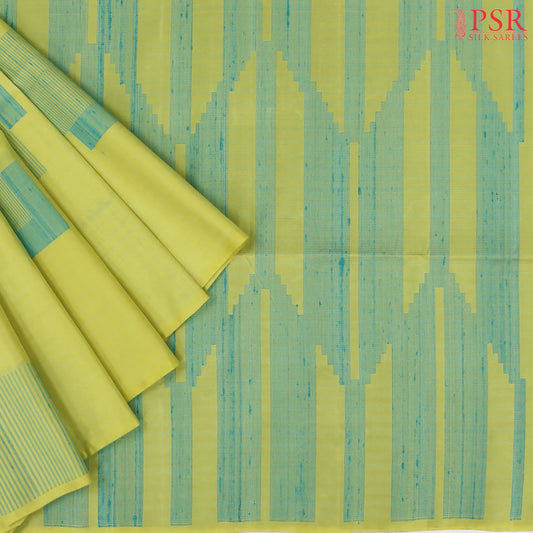
Less discussed than Korvai and Petni, Benth (also called Benku, or Petni in the southernmost weaving towns of Kumbakonam, Thirubuvanam, and Salem) is the technique used when a saree requires large geometric motifs — temple gopuram silhouettes, step pyramids, bold checks — that cannot be created in a single pass of the shuttle.
In Benth weaving, the warp or weft threads are literally turned, or "bent," back upon themselves at specific points during the weave to create the steps and angles of a geometric shape. The weaver manipulates individual threads by hand between shuttle passes, turning them back in precise directions to form sharp right angles and diagonal lines within the fabric structure itself.
The result is a motif with an almost architectural quality — raised, structured, and visible from both sides of the fabric. The temple border designs that are so recognisable in a Kanjivaram saree are often made using this technique. And the way a weaver knows where to turn each thread — which row, which column, which angle — is a spatial memory built through years of practice, not a written chart or computer instruction.
Creates geometric temple motifs Spatial memory, not notationPetni join — The pallu warp threads are hand-tied one by one to the body warp threads using looped knots. Creates a shot-colour gradient at the join.
Korvai join — The body and border wefts are interlocked row by row during weaving by two weavers throwing shuttles simultaneously. Creates the zigzag birthmark of authenticity.
The four ways a weaving family keeps its secrets
Demonstration, not instruction
The technique is shown once or twice, then the learner practices under correction. There is no verbal explanation of the mechanics — only physical adjustment when the hand position or tension is wrong. The knowledge transfers through muscle memory, not language.
Family-only transmission
For centuries, the Devanga and Saligar weaving communities of Kanchipuram have taught these techniques only to blood relatives. Marriage within the community was partly practical — it kept craft knowledge from leaving the household. Even today, the most skilled Petni knot tiers are known within the community but anonymous to the outside world.
Learning begins in childhood
Children in weaving households begin watching at three or four years old. They wind thread, carry shuttles, observe joins being made. By the time they are formally taught, their hands already have years of contextual memory. This is why adult learners — however talented — rarely master Petni to the same standard.
No written record exists
There is no published manual, no government training document, and no academic paper that fully describes how a Petni knot is tied. Textile researchers who have studied Kanchipuram for decades describe it in general terms. The specific hand movement — the loop count, the tension, the locking twist — has never been committed to writing by anyone who truly knows it.
Run your finger along the edge of a Kanjivaram saree — the point where the rich green body gives way to the crimson border. If it is a real Kanjivaram, you will feel something. A very slight unevenness. A faint ridge. A texture that is just barely different from the fabric on either side of it.
That is a Korvai. And it is not a flaw. It is the signature of a human hand.
Now find the point where the border ends and the pallu begins. Run your finger there too. On an authentic Kanjivaram, this join looks almost seamless — the colours seem to blend rather than abruptly change. But if you look closely at the back of the fabric, you will see something extraordinary: a row of tiny, perfectly spaced looped knots, each one tied individually, each one anchoring the warp thread of the body to the warp thread of the pallu. This is a Petni. And the person who tied it probably learned how from their mother before they were ten years old.
These two joins — Korvai and Petni — are the most structurally important moments in the entire life of a Kanjivaram saree. They are also the most culturally protected. In a craft tradition that spans four hundred years, no textile school teaches them, no YouTube tutorial captures the hand position correctly, and no government training programme has managed to document them in a way that a non-community learner can replicate to a high standard. The knowledge exists, entirely, inside the weaving families of Kanchipuram.
This is not an accident. It is a deliberate and ancient form of intellectual property.
The Devanga and Saligar weaving communities — the two groups credited with establishing the Kanjivaram tradition as we know it, after migrating from Andhra Pradesh during the reign of the Vijayanagara kings — organised their knowledge this way from the beginning. Craft skill was the community's only asset in a world with no patents, no contracts, and no legal protection. Keeping a technique within the bloodline was the only way to ensure it retained its value. A weaver who knew the Petni knot could charge more for their work than one who did not. A family that knew it could eat.
The Korvai technique is the one that most people have heard of. It is the iconic three-shuttle weave — two weavers sitting at opposite ends of the same loom, throwing shuttles toward each other, interlocking the body and the border thread by thread as both are woven simultaneously. The result is a join that is structurally stronger than the silk itself. If you pull a Kanjivaram body until it tears, the border will not come away. The Korvai holds.
But Petni is the quieter, more delicate secret.
Once the body of the saree is fully woven, the loom is reset. The pallu — which has been woven separately, in a different colour, with a different zari density — must now be joined to the body. The join cannot be sewn. Sewing would leave a visible seam and would puncture the silk threads. It cannot be glued. It cannot be woven over, because the body is complete and the warp is fixed. It must be tied. Thread by thread. By hand.
The Petni knot is a looped twist applied to each individual warp thread of the body, connecting it to the corresponding warp thread of the pallu. The loop has a specific tension — tight enough to hold across decades of draping, washing, and wearing, but loose enough not to pucker or distort the silk at the join point. The loop count — how many times the thread wraps before locking — varies based on the weight of the silk and the density of the pallu. A weaver making this call is making it by feel, by memory, by the specific thickness of the thread between their fingers.
When done correctly, something remarkable happens at the join: a strip of double-thickness fabric forms, where the warp threads of both sections overlap briefly before separating into their respective pallus. In this narrow strip, the two colours — the deep teal of the body and the crimson of the pallu, say — blend into what weavers call a "shot colour." It is not teal. It is not crimson. It is a shimmering third colour that exists only at that seam, visible only when the light hits it at a certain angle. It has no dye. It is made entirely from the physics of two threads crossing at the exact tension the weaver chose when tying the knot.
No machine produces a shot colour this way. A powerloom's join is clean and sharp — a hard edge between body and pallu. It is faster. It is consistent. But it does not shimmer. It does not breathe. It does not carry four centuries of muscle memory in a single looped twist of silk.
There is a third technique — less discussed but equally important — called Benth. It is used when a saree requires large geometric temple motifs: the stepped gopuram silhouette, the diamond pattern, the bold chevron. In Benth, the weaver physically bends individual warp or weft threads back upon themselves between shuttle passes to create the angle of a geometric shape. The motif is not printed, not embroidered, not woven in using a separate supplementary thread. It is built into the structure of the fabric by turning the thread itself. The spatial knowledge required — which thread, which row, which direction, how many repeats — lives entirely in the weaver's memory. It is not notated. It is not diagrammed. It is performed.
Together, Korvai, Petni, and Benth are what make a Kanjivaram irreproducible. Not the silk. Not the gold zari. The knowledge of three specific hand movements, passed from one generation to the next in a town of temples in Tamil Nadu, in the hours before sunrise, at a loom set up next to the family prayer space.
The next time you look at the border of a Kanjivaram saree, look for the zigzag. Trace it with your finger. Then look for the join where the pallu begins. Hold it up to the light and find the shot colour — that brief, shimmering strip where two threads from two separately woven sections cross for the first and only time.
You are looking at the thing that was never taught to you. The thing that was never written down. The thing that exists, in its truest form, only in the hands of the person who made it.
"Hold it up to the light and find the shot colour — that brief, shimmering strip where two threads meet for the first and only time. You are looking at something that was never written down."
The extinction risk
As younger generations in weaving families move toward salaried jobs in nearby industrial estates, the oral transmission chain breaks. When a weaver who knows Petni retires without a family member willing to learn it, that specific knowledge vanishes. There is no backup. No archive. No second copy.
Why fakes fail here
A fake Kanjivaram can copy the silk weight, the colour, even the zari pattern. But it cannot copy the Korvai join or the Petni knot, because no powerloom can perform either. The join in an imitation saree will always be a hard edge — a sewn seam, or a woven boundary. There will be no shot colour. No zigzag. No ridge under the fingertip.
What you are really buying
When you purchase an authentic Kanjivaram, part of what you are paying for is access to four hundred years of protected knowledge. The saree's price is not just silk and gold. It is the cost of a technique that a family protected for generations — and which exists in no other form on earth.